
It is certainly true that the results of last Tuesday’s special congressional election in Tennessee’s 7th Congressional District should serve as a warning to Republicans that they could have a very challenging midterm election next year. Of course, there had already been plenty of signs, so any Republican just now alarmed probably hasn’t been paying close attention or mindful of relevant history.
While the district’s overwhelmingly Republican tilt was sufficient for the GOP to avoid the humiliation of an outright loss, a 9-point win in a district that both President Trump and Sen. Marsha Blackburn won last year by 22 points is something of a black eye. Former Rep. Mark Green, whose resignation earlier this year triggered this special election, won by a similar 21 points.
The Republican nominee in this special election, Matt Van Epps, received 54 percent of the vote, while Democrat Aftyn Behn received 45 percent. The Republican underperformance was not caused by an inferior candidate or a lack of resources. Van Epps matched up well in terms of both ideology and partisanship with the district that stretches from the Kentucky state line in the north to the border with Alabama in the south, including the U.S. Army’s Fort Campbell and pieces of the Nashville metro area. Van Epps, like Green, is a West Point graduate. Van Epps went on to serve for 10 years as a U.S. Army officer, including time as a helicopter pilot. Since then, he worked in the state government in Nashville, most recently as commissioner of General Services.
Behn is a state representative and self-described community organizer who has been active in local progressive circles. Earlier this year, she posted a video boasting of “bullying” Immigration and Customs Enforcement agents who were engaging in an immigration operation. Thus, it’s safe to say that Behn would have had a better chance in a considerably more urban district more sympathetic to progressive causes than one that was held not that long ago by Blackburn, a conservative firebrand. (For readers familiar with the Washington area, this was a Takoma Park-style candidate running in a district with more than a little Hagerstown and Frederick thrown in.)
Special elections are often more about whether each party comes up short, meets expectations, or exceeds them. Republicans, who needed to avoid the embarrassment that would have been created by a very close race, dropped in over $3 million in party money to keep that from happening. Democrats would have been similarly embarrassed had they remained on the sidelines; their expenditure of $2 million-plus covered their flanks against charges from progressives that the party was insufficiently supportive of Behn’s candidacy.
Some Democratic activists, online donors, and sympathetic journalists got a bit over their skis, suggesting that a Democratic upset was possible when a victory was never realistic. Trying to extrapolate the meaning of Democrats’ overperformance in a pair of very Democratic districts in two previous special elections this year, while Republicans underperformed in another pair of very Republican districts, was a pretty thin argument. We heard the same refrain before the 2024 election, after Democrats had beaten the point spread in elections earlier in the year.
But looking at the vote totals for Democrats and Republicans in the Tennessee special election compared to those in the same district last year does illustrate a chronic problem that a president’s party has at this point in their terms. Members of a president’s party are typically either complacent at this point, or a little or a lot disillusioned, but they are rarely pumped up and energized. Those in the party that lost the presidential election are often still angry about the loss, hating anything and everything that the opposition president and party are doing, and looking forward to payback.
Special elections are always going to have lower voter turnout than the preceding presidential election. In this case, the 179,986 who voted in the special were far fewer than the 322,656 who voted a year ago, a drop of 44 percent. But look at the vote totals by party: Behn pulled only 41,633 fewer votes than Megan Barry, the Democratic nominee in November 2024, but Van Epps received 94,976 fewer votes than Green, the Republican nominee in the previous election.
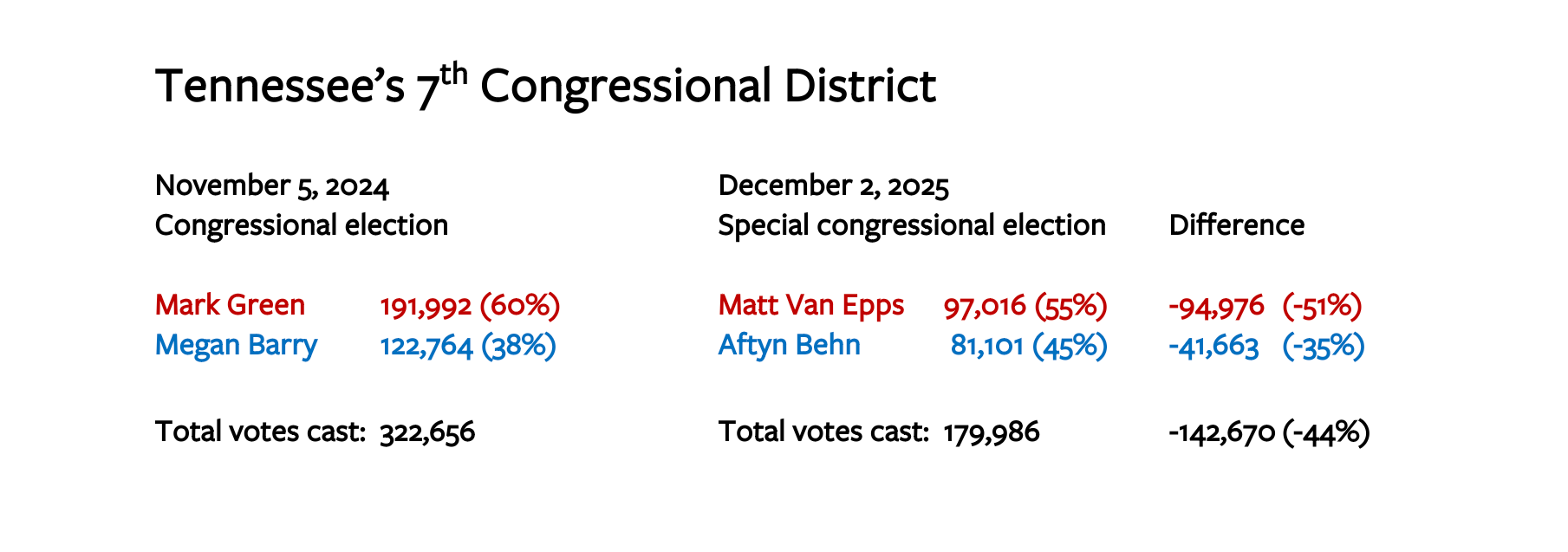
What happened in Tennessee-07 is a good example of how the party of a sitting president goes into a midterm slump, and why the average midterm outcome since the end of World War II is a House loss of 26 seats for the incumbent party.
Moreover, this will not be a year akin to 1998 or 2002, the only two years since then when the president’s party has gained House seats. The former was a backlash against Republicans for trying to impeach President Clinton, whose job-approval rating at the time of the midterm was 66 percent (30 percent disapproved). President George W. Bush’s midterm came almost 14 months after 9/11, an event that sent his approval rating to the presidential record level of 90 percent. At the time of the midterm, it was still a healthy 63 percent (29 percent disapproved).
Before he left office, Bush’s approval set a modern record low of 25 percent. It’s remarkable that a president could set both records; of course, that was before things got quite as partisan as they have become now, allowing for such elasticity.